


 0
0
 0
0
Why Bot Problems Are Getting Worse
Let me give you a reality check: I’ve spent the last eight months testing random video chat platforms, and the bot problem isn’t getting better — it’s getting worse. Way worse.
Last month alone, I counted bot interactions on six different platforms. On one site, nearly 40% of my matches were clearly automated. That’s not an anomaly — it’s the new normal.
Why are bots everywhere? Simple economics. Running a video chat platform is expensive. Server costs, bandwidth, moderation — it adds up fast. Some platforms fill the gap with fake users to make their user base look bigger than it actually is. Others don’t care because they’re running scams anyway.
The bots have gotten sophisticated too. Early bots were obvious — broken English, generic responses, no memory. Today’s bots can hold semi-coherent conversations, use proper grammar, and even respond to specific questions. They learned from being detected.
If you’re using Omegle alternatives without knowing how to spot bots, you’re basically wasting your time. Half your conversations might be with scripts, not people.
How to Identify Bot Profiles
After hundreds of interactions, I’ve developed a mental checklist. Use it. You’ll save yourself a lot of frustration.
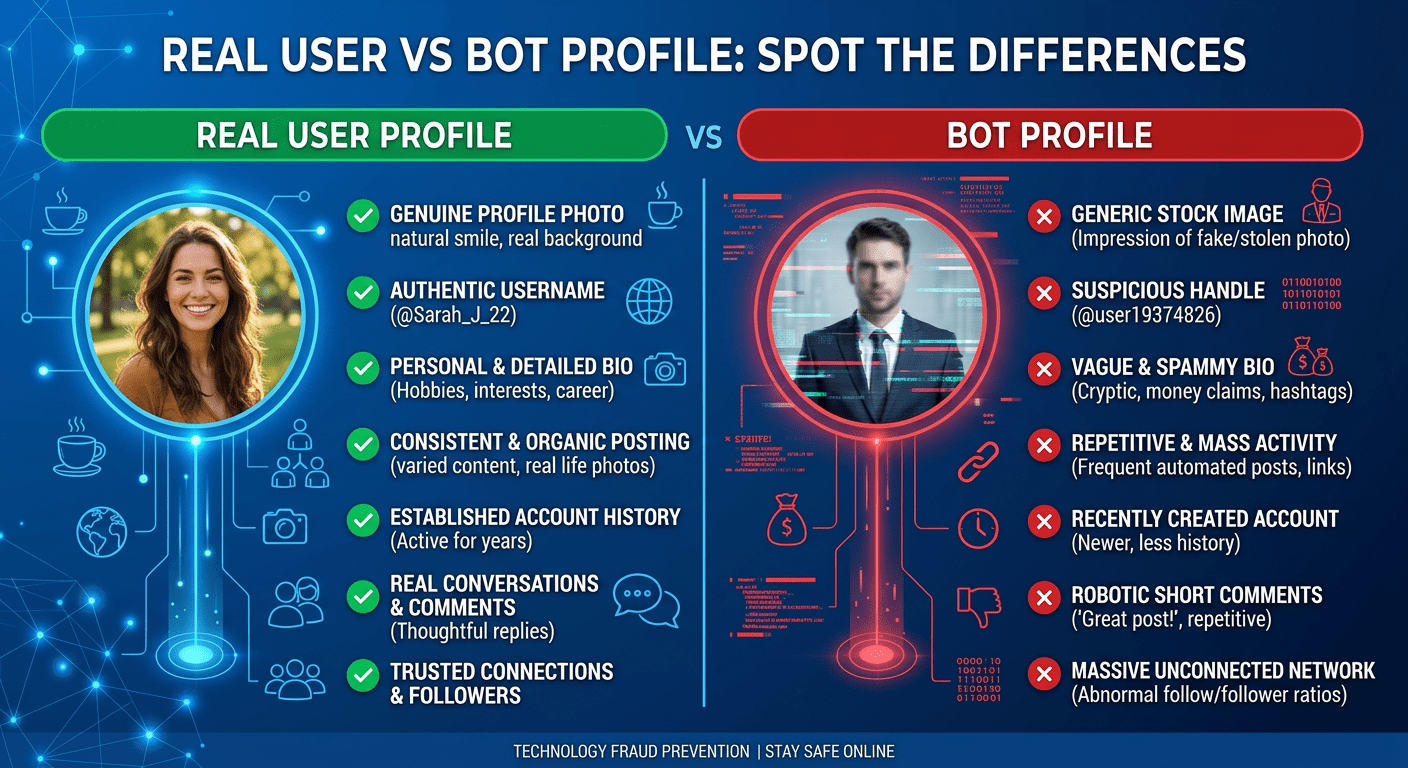
Language and Response Patterns
The biggest tell is how they talk. Real people have quirks, typos, and inconsistent writing styles. Bots are too consistent — that’s their weakness.
Watch for these patterns:
Perfect grammar under pressure. Most people make typos, especially when typing fast on mobile. A bot will respond with flawless grammar every single time, even if you ask something complicated or casual.
Generic responses that could apply to anything. If you ask “What do you do for work?” and get “I enjoy connecting with people and exploring new experiences” — that’s a bot. Real people answer specific questions specifically.
No follow-up questions. Conversations with real people flow both ways. Bots typically ask one question then go silent, or answer yours without reciprocating. They don’t care about you — they’re just running a script.
Lightning-fast responses. Some bots are programmed to reply instantly. A real person needs at least 2-3 seconds to read your message and type a response. Instant replies (under 1 second consistently) are a red flag.
Profile Photo Red Flags
Profile pictures tell you a lot. Here’s what to look for:
Stock photos. If the image looks like it came from a modeling website or stock library — it probably did. Run a reverse image search sometime. You’ll be surprised how often the same photo appears on multiple “different” profiles.
Beautiful but generic faces. Perfect lighting, perfect skin, perfect composition. Real people have imperfect photos — selfies at weird angles, casual shots in natural light. Professional-looking photos on a random chat profile are suspicious.
No other content. Bots rarely have full profiles with bio, interests, or additional photos. The profile exists solely to show you one attractive face.
Inconsistent age or appearance. Sometimes bots recycle photos from different sources. The face might look 25 in the photo but the profile claims something different. Trust your eyes more than the text.
Behavioral Clues
Actions speak louder than words. Watch what they do:
Immediate pivot to another platform. Right after connecting, they immediately suggest moving to Telegram, WhatsApp, or some other app. Why? Because on the original platform, their behavior can be reported. On external apps, they’re insulated.
Escalating conversation topics. Normal people take time to warm up. Bots push toward personal or “adult” topics fast — within minutes, sometimes seconds. This is designed to hook you before you realize something’s off.
No memory between “sessions.” Some platforms let you reconnect with the same person. If you do and they don’t remember anything from before — different name, different story, same pattern — you’re dealing with a bot reset.
Refusal to video chat. They want to text but suddenly can’t do video. Any excuse — “my camera is broken,” “I’m having connection issues,” “I’m shy.” Real people who signed up for video chat will actually use video. Bots can’t generate convincing fake video in real-time.
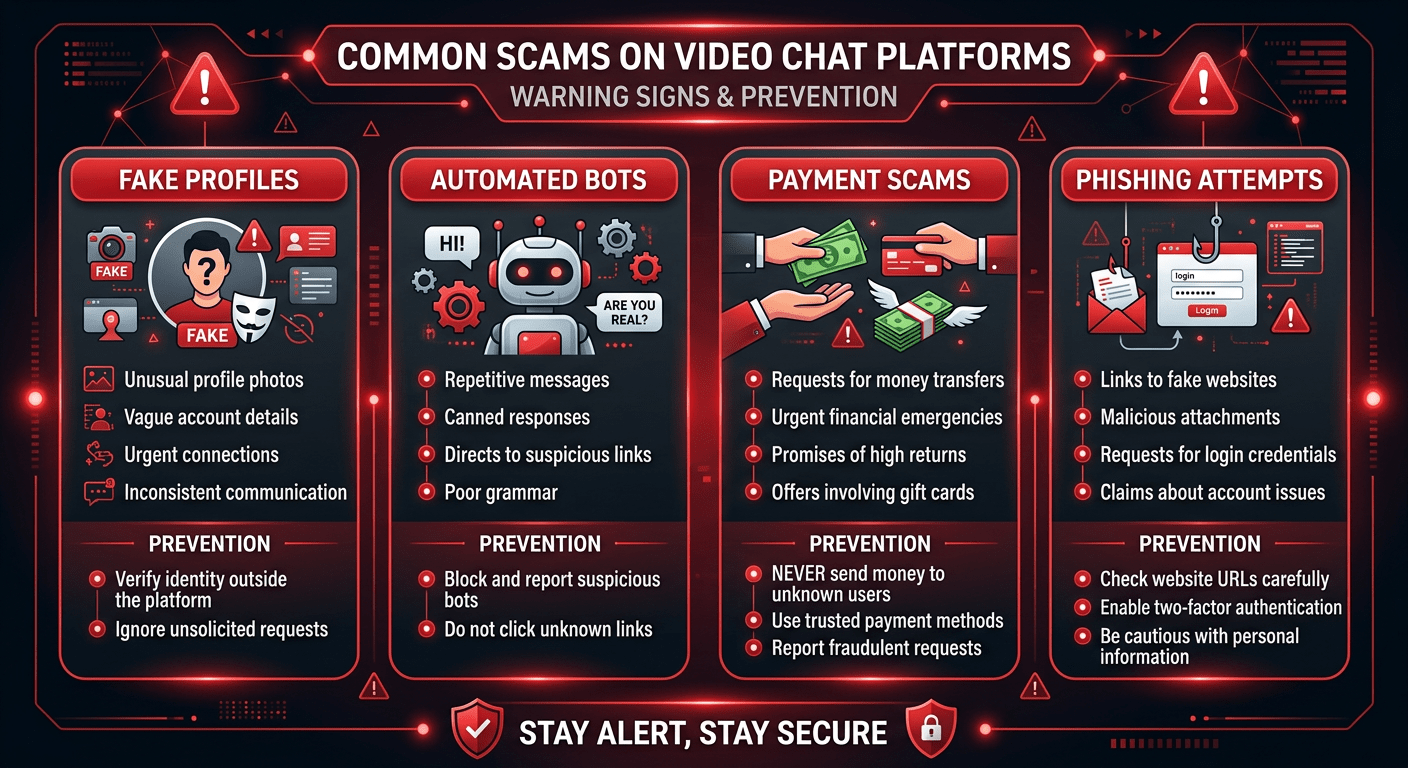
Common Scam Patterns on Video Chat
Bots aren’t just annoying — they’re often part of larger scam operations. Here’s what I see most frequently:
Premium content scams. The bot engages you in conversation, builds rapport, then mentions they make money on a private platform. “Subscribe here” or “Join my onlyfans” — all pre-scripted. The person in the photo probably doesn’t exist.
Crypto and investment schemes. “I make money trading, want to know how?” They guide you to a website, sign-up form, or DM exchange. The “investment opportunity” is the real product here, not the conversation.
Verification scams. “To continue chatting, you need to verify you’re 18+” — click this link, enter your phone number. The verification is fake; your phone number gets sold to telemarketers or used for SIM swapping.
Catfish-to-extortion. A real person (not a bot) engages you, builds trust, then suddenly there’s “evidence” of the conversation. They threaten to release it unless you pay. This is increasingly common and genuinely dangerous.
Fake meeting scams. They express interest in meeting up, then need “travel money” or “hotel booking” — send gift cards or wire transfer. The meeting never happens. Classic long-con scam.
How to Protect Yourself
Here’s what actually works against bots and scammers:
Use the platform’s blocking and reporting tools. Don’t feel bad about it. Every report matters. Platforms with active user reporting have better detection systems — help them help you.
Never share your phone number or personal details early. If someone insists on moving to WhatsApp or text within five minutes, that’s a red flag. Keep conversations on the platform where there’s at least some accountability.
Run reverse image searches on profile photos. Takes 30 seconds, saves hours of frustration. If the photo appears elsewhere under a different name or context, you know it’s stolen.
Trust the speed and consistency of responses. If someone replies instantly every single time, with perfectly formatted text, no typos, and consistent enthusiasm — you’re probably talking to a script.
Verify with video (but be careful). Real people should video chat. But be aware: pre-recorded videos can be played during calls. Look for genuine interaction — do they respond to what you’re actually saying in real-time?
Don’t engage with anyone pushing you toward external platforms or payment. Legitimate connections happen on the platform. If someone immediately wants to move you somewhere else, they have an agenda.
I’ve found that the best protection is simply knowing these patterns exist. Once you understand how bots work, you spot them instantly. It’s like learning a magic trick — once you know the secret, you can’t unsee it.
Frequently Asked Questions
Q: Are all bots on video chat sites scam-related?
A: Not necessarily. Some bots are used just to inflate user counts — making the platform appear more popular than it is. Others are for advertising. But many bots, especially ones that push toward external platforms or payment, are definitely running scams. Treat any bot interaction as potentially dangerous.
Q: Can bots actually hold conversations?
A: They can simulate conversations, but poorly. Bots follow scripts and keywords. Ask something unexpected or use slang, and you’ll get generic or nonsensical responses. Real conversations flow naturally; bot conversations feel scripted even when they’re technically coherent.
Q: Which video chat platforms have the most bots?
A: Newer, smaller platforms tend to have higher bot ratios because they lack the resources for effective anti-bot measures. Established platforms with better moderation tend to have fewer, but no platform is completely bot-free. Your best defense is learning to spot them yourself.
Q: Is there any way to report bots effectively?
A: Yes, but effectiveness varies by platform. Use built-in reporting tools immediately when you spot a bot. Provide specific details — why you think it’s a bot, what pattern you noticed. The more detailed reports users submit, the better platforms can train their detection systems.
Q: Will using a VPN help with bot problems?
A: Not directly. VPNs protect your privacy from IP logging, but they don’t filter out bots. Some platforms do block VPN users to reduce bot access, creating a tradeoff. Focus on learning bot detection patterns rather than expecting technology to solve the problem.
Further Reading
- Learn more about social bots and automated accounts from Wikipedia
- General information about online fraud and scams
- More scam prevention guides by zacharyhall